In the beginning – There were no Recreation Facilities
The City of Los Altos, — incorporated in 1952 — did not have much in the way of recreation or park facilities to speak of until the 1970’s. Mayor Roy Lave is recognized as the person who first created significant City park facilities for Los Altos. Today we have Redwood Grove, Shoup Park, Lincoln Park, and several others.
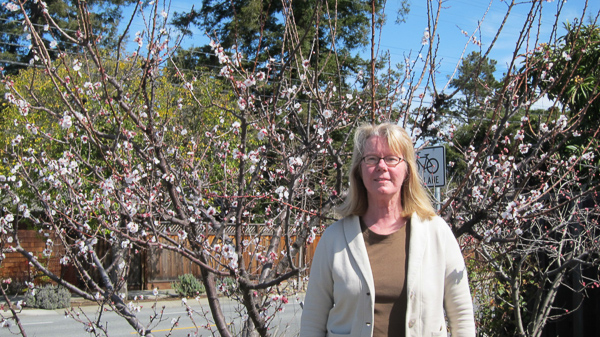
A Los Altos woman with her apricot tree, still enjoying the “semi-rural” lifestyle
Ruralists incorporate to protect life-style, not to gain recreation
As Lalahpolitico reads the local history books, it seems that the impetus for incorporation of the City of Los Altos in 1952 was to keep the City of Mountain View from incorporating the orchard areas around El Monte and Almond Ave. as 1/8 – 1/6 acre tract homes with sidewalks, curbs, streetlights and sewers. Apparently folks in living in the Los Altos area hills and living in Paul Shoup’s University Avenue/ Orange Avenue real estate development project [1906-1920’s] did not relish the prospect of dense, “modern” city development coming up to their doorsteps. Their concern in 1952 was well-founded, not mere paranoia—Mountain View had recently incorporated Los Altos area vineyards along the south side El Camino near El Monte, creating the Gemello neighborhood of small single-family homes. Palo Alto was incorporating areas along the north side of El Camino near San Antonio Road.
These City of Los Altos Founding Fathers, notably John Gardner and other movers and shakers (some of who lived in the hills) led the effort to incorporate. The vote was 51% to 49%, and the City Fathers were able to ZONE the undeveloped orchards of what is today “North” Los Altos as 1/2 acres, 1/3 acres, eventually setting a minimum lot size of 10,000 square feet. And of course, when creating new housing subdivisions, not requiring any carve out for parks, nor requiring sidewalks, curbs, street lights or sewers … was a real gift to the land owners and developers of those days. The only “carve out” of private land was for schools. Los Altos school district purchased additional school site land beginning in 1946 as the baby boom ramped up. Then as now, school sites function as de facto parks. Over several decades, the City repeatedly annexed unincorporated county areas south/east of El Monte and Springer. Today, of course, the City of Los Altos extends to Cupertino.
1950’s promise to keep our city a non-city
In the 1950’s, Mr. Gardner and his incorporation compatriots promised voters that becoming a city was they only way to maintain a “semi-rural” lifestyle by controlling “city” zoning to suppress growth, but that the costs and overhead of running a city would be kept to an absolute minimum. The new North Los Altos tract homes of the 1950’s and 60’s were marketed as “mini-estates.” Traffic was zilch. Kids wore sneakers and played unattended in the huge backyards of their brand new, “palatial” 2000 to 2500 square foot ranch homes. They also played in the streets and in the remaining patches of apricot and nut orchards.

The Gilbert Smith House and farm was the first major City of Los Altos costly acquisition. The city has a history of minimizing spending.
50s and 60s – early years of city spending minimization
The City obtained its first public land in 1954 when it purchased the J.Gilbert Smith house and its 10 acres of farm and orchard along on San Antonio Road and Edith Avenue. The Smiths very much wanted the City to get the farm. The sales contract let Mrs. Smith lived in the house till her death in 1973. Today the Smith land is what we know as the 1 N. San Antonio Road Civic Center – city hall, police, youth center, library and of course the History Museum and Smith House. Right next door back then in 1954 were the San Antonio and Hillview Schools with probably over 1000 children attending.
Immediately after the 1952 incorporation, city business and the new police department were run out of the shops in the downtown triangle. Soon after the Smith land purchase, City money was found to build a minimal city hall for the building inspection department to enforce the new city zoning, and also for a police building with a one cell jail!
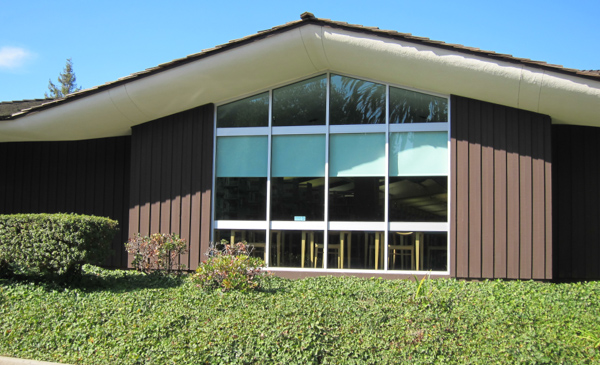
The first library building, built and owned by the City was real simple. As is the current library. Los Altos Measure A does not affect the library, except maybe to remove a bit of parking and possible the 3 oaks around that parking area.
At first the Santa Clara County library services were still just a bookmobile book drop to a shop downtown. [Even today unincorporated areas of the county are served by a bookmobile route.] Eventually City money paid for a simple library building at 1 S. San Antonio Ave. Over the years it was remodeled and expanded: the City still owns and maintains it, leasing it to the library service operator, Santa Clara County Libraries (SCCL). [The building was expanded with City money in the 1980’s].
In those early days of the 1950’s, the City activities and costs must have been really, really small. The zoning regulations probably fit on 10 pages. Yet, Lalahpolitico has met elderly, long-time local residents who so dislike being “citified” by incorporation that they have moved again and again to avoid being annexed to the City. Many of the early 1950’s residents were do-it-yourself (DIY) builders and landscapers and report they felt chafed under the scrutiny of the tightened building inspections. And they certainly disliked paying for an inspection of their new DIY extra bedroom or outbuilding. Oh, and of course property taxes must have gone up at least a bit compared to unincorporated county taxes.
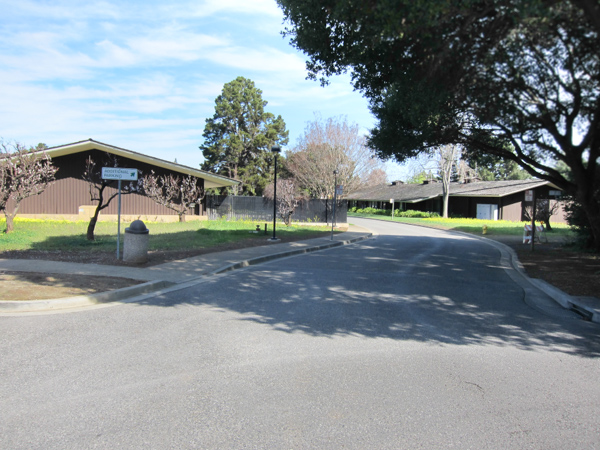
Los Altos Measure A does not affect the Los Altos Youth Center on the left or the Police Station on the right. LACY was paid for in part by the Boy Scouts. The police station was built with city money.
First city recreation facility LACY – private donations
In the 60’s the Boy Scout troops in the the area raised private money to help pay to build the Youth Center building, but the City owns and maintains it. So the LAYC was arguably the FIRST recreation program and it was constructed with significant private money, but on public land.
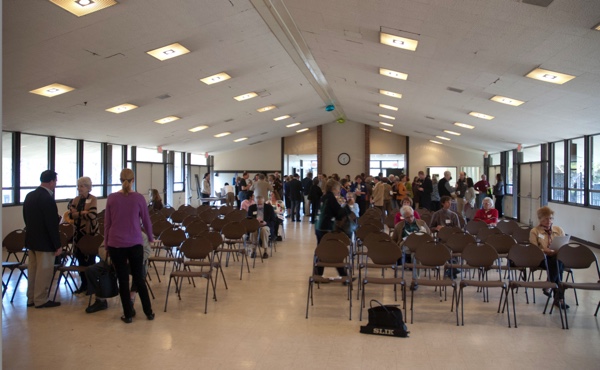
Interior of Los Altos Youth Center. The Boy Scouts did the fundraising to help pay for this modest building. Today the city owns, maintains and operates it. It is rented for events.
Our $0 Hillview Recreation Facility – created by the 70’s demographic collapse
When LASD board trustees were selling off schools as enrollment plummeted in the 70s, the City swooped in to buy the Hillview School and its parcels – saving it from development as tract homes or an affordable housing multi-tenant project. Lalahpolitico was informed that the purchase was actually $0 capital cost, because sale of 2 or 3 acres of the parcel for development as homes and an office building financed the acquisition. There was no bond or public vote, just City Council actions. Some residents believed the two school parcels were being “banked” for future potential use as a school again when the need arose.